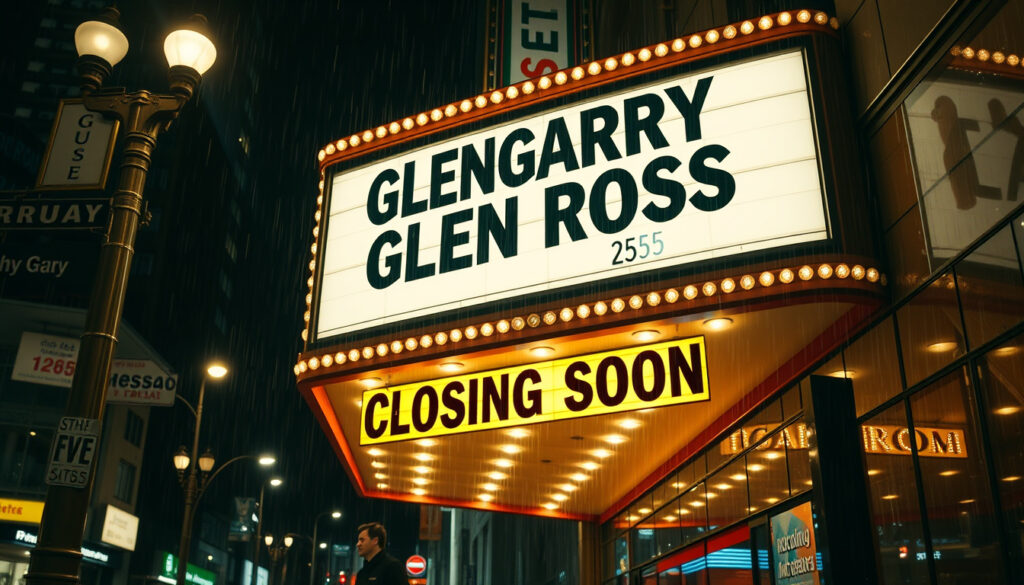
Glengarry Glen Ross Broadway 2025: Cast, Reviews, Closing
If you’ve ever worked a room where the stakes felt life-or-death — or you just love watching great actors tear into each other — this was the revival to beat. David Mamet’s Pulitzer Prize-winning play returned to Broadway in 2025 with a cast that read like a comedy-crime dream team: Kieran Culkin as the smooth-talking sales closer, Bob Odenkirk as the desperate veteran, and Bill Burr as the angry junior rep who wants out.
Revival Premiere: March 31, 2025 · Venue: Palace Theatre, 160 W 47th St. · Key Stars: Kieran Culkin, Bob Odenkirk, Bill Burr · Director: Patrick Marber · Gross: $35.8M
Quick snapshot
- Whether a cast recording or live stream will ever surface — producers have not announced plans
- Any confirmed touring productions or international offshoots remain unannounced as of closing
- Bob Odenkirk earned a 2025 Tony nomination for Best Featured Actor in a Play — the only acting nomination among the ensemble (BroadwayWorld)
- The production recouped its initial investment, a rare feat for straight plays on Broadway (BroadwayNews)
Key facts
The production data below reflects figures reported by Playbill for the 104-performance run.
| Label | Value |
|---|---|
| Playwright | David Mamet |
| 2025 Director | Patrick Marber |
| Original Broadway Run | March 25, 1984 – February 17, 1985 |
| Total Performances (Original) | 378 |
| 2025 Broadway Run | March 10 – June 28, 2025 (104 performances) |
| Venue | Palace Theatre, 160 W 47th St., New York |
| Running Time | 1 hour 45 minutes (one 15-minute intermission) |
| Total Gross | $35,845,723.30 |
| Average Ticket Price | $219.17 |
Is Glengarry Glen Ross still playing on Broadway?
The 2025 revival is now closed. Previews began March 10, 2025, at the Palace Theatre, with official opening night on March 31, 2025. The production ran for 104 performances before closing June 28, 2025, according to Playbill records. This was the play’s third Broadway revival — the original ran 378 performances at the John Golden Theatre from March 1984 through February 1985, per Wikipedia.
The production achieved near-sellout capacity throughout its run, averaging 98.64% occupancy with an average ticket price of $219.17, per Playbill. Weekly grosses regularly topped $2 million, including a $2.75 million week ending May 25, 2025, that represented the production’s high-water mark.
If you missed this run, no return engagement has been announced — and Broadway revivals of straight plays rarely come back within five years of closing.
Who played in Glengarry Glen Ross on Broadway?
The 2025 revival assembled a cast drawn heavily from film and television, with Kieran Culkin (Academy Award winner for A Quiet Place: Day One) anchoring the production as Richard Roma, the smooth-talking closer whose clients receive the premium “Glengarry” leads. Bob Odenkirk, best known for playing Saul Goodman across six seasons of Better Call Saul, took on Shelley Levene — the aging sales rep desperate for any deal he can close. Comedian Bill Burr, famous for F Is for Family and his standup specials, played Dave Moss, the angry junior rep who plots to steal the lead sheet with his partner.
The ensemble rounded out with Michael McKean (Best in Show, Better Call Saul) as George Aaronow, the conflicted middle-manager type who goes along with whatever the room decides. Donald Webber Jr. played office manager John Williamson, the gatekeeper who holds the physical lead sheet under lock and key. John Pirruccello appeared as James Lingk, the nervous client who signs a contract under pressure and immediately regrets it. Howard W. Overshown played Baylen, completing the cast per Playbill.
The production marked the third Broadway revival of Mamet’s 1984 play. Patrick Marber, a Tony and Olivier Award-winning playwright and director, helmed the production. Jeffrey Richards produced; his track record includes shepherding the two previous revivals to Broadway, per BroadwayNews.
The casting strategy targeted audiences who knew Culkin, Odenkirk, and Burr from screen work but might never have seen a live Mamet play — a deliberate move to fill 1,700 seats at $219 average without relying on traditional theater subscribers.
Is Glengarry Glen Ross worth seeing on Broadway?
Critics offered mixed but generally respectful assessments. The Guardian noted that the star-studded cast brought fresh energy to the material without fully resolving the play’s inherent staging challenges — the second act’s lengthy monologue format tends to slow momentum even for accomplished actors. The New York Theater review acknowledged the impressive production values and strong individual performances while questioning whether the staging offered a new interpretive angle on a work audiences have seen multiple times on screen and stage.
Bob Odenkirk earned the production’s only acting nomination at the 2025 Tony Awards — Best Performance by an Actor in a Featured Role in a Play — per BroadwayWorld. The revival also secured nominations from the Drama League (Outstanding Revival of a Play) and the Outer Critics Circle (Outstanding Revival of a Play), with Kieran Culkin nominated for Distinguished Performance by the Drama League and Outstanding Featured Performer by the OCC, per Wikipedia.
Upsides and downsides
Upsides
- Star power drew first-time Broadway audiences who may never have seen a Mamet play live
- Near-sellout run proves commercial viability — the production recouped, rare for straight plays
- Odenkirk’s Tony nomination validates the casting gamble paying off artistically
- Average capacity of 98.64% means almost every seat generated revenue across the run
Downsides
- Critics questioned whether the production offered a fresh enough angle to justify another revival
- The play’s two-interview structure and monologue-heavy second act remain tough for casual viewers
- No cast recording or streaming option — the production exists only in audience memory and reviews
- Ticket prices averaged $219.17, pricing out the theater students and young professionals who made the original a cult hit
What is the famous line in Glengarry Glen Ross?
The line that most people carry out of any Glengarry Glen Ross production — whether they’ve seen the 1992 film with Al Pacino, the 1984 Broadway original, or any revival — is “Always be closing.” In the play’s signature scene, Richard Roma delivers a lengthy pitch to a skeptical prospect, drilling the ABC mantra into the audience’s skull: “A.B.C. Always be closing. Always be closing.”
The American Film Institute ranked “Always be closing” at number 41 on its 100 Years…100 Movie Quotes list, cementing its status as one of the most recognizable lines from a prestige drama, per Ticketmaster. The line works as shorthand for an entire ethos — the relentless pressure to perform, to deliver numbers, to never let a prospect walk out the door without signing. Mamet stripped sales pitches down to their most brutal essence, and audiences recognized it as truth.
Beyond ABC, the play offers a catalog of aggressive one-liners: “You see? You see? That’s what they want. They want the A priority. That’s what we give them. A.B.C. A priority.” The language itself becomes a weapon — cutting, repetitive, designed to wear down resistance. In the 2025 revival, Kieran Culkin delivered Roma’s monologues with a cool detachment that made the manipulation feel almost clinical.
“A.B.C. Always be closing. Always be closing.” — Richard Roma (David Mamet, Glengarry Glen Ross, 1984)
Why is Glengarry Glen Ross so famous?
The play became a cultural touchstone for reasons that go beyond its original Broadway run. David Mamet wrote Glengarry Glen Ross in 1984, winning the Pulitzer Prize for Drama in a year when the committee honored a play about telemarketers cutting each other down for sales leads. It opened on Broadway March 25, 1984, ran 378 performances, and immediately entered the theatrical canon as a play that other actors wanted to perform — and audiences wanted to see repeatedly.
The 1992 film adaptation, directed by James Foley and starring Al Pacino, Jack Lemmon, Ed Harris, Alan Arkin, and Kevin Spacey in early roles, elevated the material to a much broader audience. The film compressed the play’s two-act structure into a tight 100 minutes, and the ensemble cast delivered Mamet’s rapid-fire dialogue with an intensity that felt almost documentary. Pacino’s “Look, it’s my name on the contract” monologue became a master class in acting that film students still study frame by frame.
The play’s world premiere actually occurred at London’s National Theatre in 1983, one year before the Broadway debut, per TheaterMania. The London production gave the work its first professional staging, and the 2025 Broadway revival marked the third time the play returned to the Main Stem — a rarity for non-musicals, which typically get one revival at most before fading into regional theater stock.
What keeps Glengarry Glen Ross alive is its scalability: the material works equally well in a Broadway house with $200 tickets and screen-famous actors, or in a high school auditorium with minimal sets. The dialogue is dense enough to reward close listening but punchy enough to land through walls. Salespeople see themselves in it; management consultants analyze it; actors treat it as a showcase piece for showcasing monologues. It occupies a rare space in American drama — a play that is simultaneously a commercial product and a serious work of art.
The play’s fame creates a paradox for revivals: audiences arrive knowing the lines from the film, which means actors must compete with memory. Culkin and Odenkirk dealt with this by leaning into the comedy beneath the aggression — letting Burr and McKean provide the laughs while they held the drama’s center.
Timeline
The timeline below traces the play’s progression from London workshop to its third Broadway revival.
| Date | Event |
|---|---|
| 1983 | World premiere at London’s National Theatre |
| March 25, 1984 | Original Broadway premiere at John Golden Theatre |
| February 17, 1985 | Original run closes after 378 performances |
| 1992 | Film adaptation released, starring Al Pacino and Jack Lemmon |
| March 10, 2025 | 2025 revival begins previews at Palace Theatre |
| March 31, 2025 | 2025 revival officially opens |
| May 11, 2025 | Production sets new Palace Theatre house record with $2.4 million weekly gross |
| June 28, 2025 | 2025 revival closes after 104 performances |
The pattern shows a play that spent over three decades building cultural momentum before returning to Broadway with a cast designed to attract audiences outside traditional theater demographics.
What we know and what remains unclear
High confidence facts: the play’s Pulitzer Prize status, the 1984 publication date, the cast roster from the Palace Theatre production, the financial performance data ($35.8 million gross, 98.64% capacity, recoupment), the award nominations, and the closing date of June 28, 2025 are all verified across multiple sources.
What remains unclear: whether the production captured any video for future release, whether a cast recording exists in any archive, and whether Jeffrey Richards or any producing partner has discussed a touring production. No announcements have been made regarding international stagings or regional theater licensing, which typically become available within 12-18 months after a Broadway closing for a play this high-profile.
“The only thing that matters is getting that contract signed. Not what you think, not what you want — what does the client want? What does the client need? A.B.C.”
— Richard Roma, Glengarry Glen Ross, delivered by Kieran Culkin (2025 Broadway revival)
For ticket buyers in 2025 who caught the production: the experience lived and died in the room. No recording exists to replay the Culkin-Odenkirk interplay that critics and audiences described as electric. Those who went saw something unrepeatable — which, for a play about the urgency of the moment, feels appropriately final.
Related reading: Cast of Red One Film · Cast of Paddington 3
todaytix.com, broadway.com, broadway.com, newyorktheatreguide.com, ibdb.com, telecharge.com
The 2025 Broadway revival starring Culkin, Odenkirk and Burr builds directly on the storied cast from Pacino to Culkin across decades of productions.
Frequently asked questions
When does Glengarry Glen Ross Broadway 2025 end?
The 2025 revival closed June 28, 2025, at the Palace Theatre after 104 performances. No return engagement has been announced. The production began previews March 10, 2025, and officially opened March 31, 2025.
How do I get Glengarry Glen Ross Broadway tickets?
The production has closed. For future revivals, check Ticketmaster or the official site glengarryonbroadway.com when a return engagement is announced. Tickets for the 2025 run averaged $219.17.
What are the Glengarry Glen Ross Broadway 2025 reviews?
Reviews were mixed but respectful. The Guardian called the staging impressive while noting interpretive challenges. The New York Theater review praised individual performances but questioned whether the production offered a fresh enough angle. Bob Odenkirk earned a 2025 Tony nomination for Best Featured Actor in a Play.
Is Bill Burr good in Glengarry Glen Ross Broadway?
Bill Burr played Dave Moss, the angry junior sales rep who plots to steal the lead sheet. Critics noted that Burr brought his standup energy to the role, providing dark comic relief in scenes that can otherwise feel relentless. The casting was considered part of the production’s strategy to attract audiences unfamiliar with live theater.
What is the Glengarry Glen Ross runtime on Broadway?
The production ran 1 hour 45 minutes with one 15-minute intermission, per Playbill. This matches the runtime of the 1992 film version.
Where is Glengarry Glen Ross playing on Broadway?
The 2025 revival played at the Palace Theatre, located at 160 W 47th St., New York, NY. The venue seats approximately 1,700 and is one of Broadway’s larger theaters for non-musical productions.
Is there a Glengarry Glen Ross Broadway cast recording?
No cast recording or live capture was announced for the 2025 revival. The production recouped its investment and closed without any recorded document of the performances — meaning the Culkin-Odenkirk-Burr interpretation exists only in audience memory and critical reviews.
More related posts
 Oven Baked Chicken Thighs: Times, Temps & Crispy Tips
 Symptoms of Low Iron: 10 Common and Unexpected Signs
 Cast of The Girlfriend (TV Series): Full Actors List
 A hton Jeanty NFL Draft: Pick, Team, Combine & Contract
 New Food Pyramid 2026: Cardiologists Weigh In on Heart Health
 Current Time in Nigeria: WAT and UK/Ghana Comparisons
 English to Latin Translator: Best Free Online Tools
 What Foods Neutralize Stomach Acid Immediately – Bananas, Oatmeal Relieve Heartburn