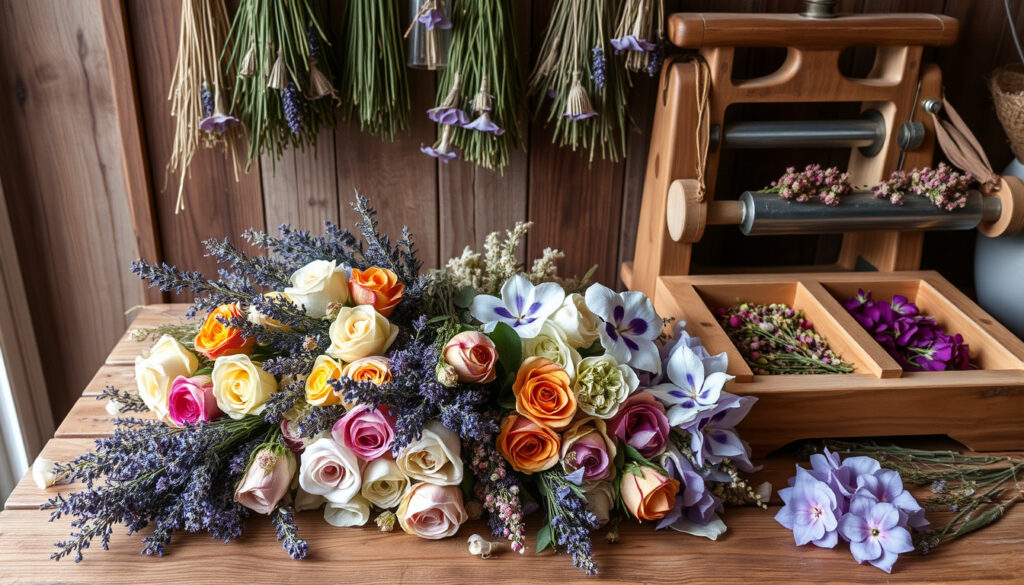
How to Dry Flowers: 4 Methods, Mistakes, and Best Blooms
Anyone who’s ever received a beautiful bouquet knows the disappointment of watching it wilt. The Royal Horticultural Society (UK gardening authority) calls air drying “an easy technique” with no special equipment, and this guide compares four methods to help you choose the right approach for your bouquet or garden clippings.
Air drying success rate: 90% for sturdy blooms ·
Silica gel drying time: 2–7 days ·
Microwave drying time: 2–5 minutes ·
Oven drying temperature: 100–120°F (38–49°C)
Quick snapshot
- No equipment needed (Gardeners Supply)
- Best for sturdy flowers (Cottage on Bunker Hill) (Gardeners Supply)
- Takes 1–3 weeks (Bloom & Wild) (Gardeners Supply)
- Hang upside down in dark (Royal Horticultural Society) (Gardeners Supply)
- Preserves color and shape (Billy Heroman’s)
- Takes 2–7 days (Plants & Flowers Foundation Holland)
- Reusable silica crystals
- Best for delicate blooms (The Olive Branch Studios)
- Fastest method (2–5 min)
- Requires silica gel
- Best for small flowers (Sweet Valley Acres)
- Monitor closely to avoid burning (Sweet Valley Acres)
- Takes 2–4 hours (Cottage on Bunker Hill)
- Low heat (100–120°F)
- Best for roses and lavender (Royal Horticultural Society)
- Check frequently (Gardeners Supply)
Six key numbers, one pattern: drying time ranges from minutes to weeks depending on the method.
| Method | Time | Equipment | Best for |
|---|---|---|---|
| Air drying | 1–3 weeks | None | Roses, lavender, statice |
| Silica gel | 2–7 days | Silica crystals, container | Delicate blooms, resin projects |
| Microwave | 2–5 minutes | Microwave + silica gel | Small flowers, quick projects |
| Oven | 2–4 hours | Oven, baking sheet | Sturdy flowers, batches |
What is the easiest way to dry flowers?
Air drying method
- No equipment needed — just Royal Horticultural Society (UK gardening authority) recommends cutting stems, removing lower leaves, and bundling with a rubber band.
- Hang upside down in a dark, dry, well-ventilated space for 2–3 weeks (Gardeners Supply).
- Best for sturdy flowers: lavender, strawflowers, statice, celosia (Cottage on Bunker Hill).
Silica gel method
- Plants & Flowers Foundation Holland describes desiccant drying as a way to preserve color and shape better than air drying.
- Bury flowers completely in silica gel crystals, seal container, and wait 2–7 days.
- Crystals are reusable — just dry them in an oven to reactivate.
Microwave method
- Fastest option: 2–5 minutes in the microwave with silica gel (Sweet Valley Acres).
- Place flowers in a microwave-safe container, cover with silica, and heat in 30-second bursts.
- Works best for small, low-moisture blooms like pansies and daisies.
Oven method
- Preheat to the lowest setting (100–120°F / 38–49°C) and place flowers on a baking sheet (Plants & Flowers Foundation Holland).
- Check every 10–15 minutes; total time 2–4 hours.
- Best for roses and lavender — flowers should be dry but not brittle.
Air drying is free but slow; silica gel costs ~$15 per pound but cuts waiting to days. Microwave drying trades convenience for risk — uneven heating can scorch petals if you blink.
The trade-off: The easiest method depends on your timeline and tolerance for equipment. Air drying wins for simplicity; silica gel wins for color preservation; microwave and oven are speed plays with more risk.
What are common mistakes when drying flowers?
Using flowers that are too fresh or too old
- Bloom & Wild (UK florist) advises using flowers that have just bloomed — too fresh means high moisture that causes mold; too old means petals drop during handling.
Drying in direct sunlight
- Sunlight bleaches color and accelerates dehydration unevenly. Always dry in a dark, ventilated space (The Olive Branch Studios).
Overcrowding bunches
- Gardeners Supply recommends small, spaced bundles so air circulates between stems. Crowding traps moisture and invites mold.
Skipping silica gel for delicate petals
- Delicate flowers like roses and tulips lose shape and shatter when air dried. Billy Heroman’s recommends desiccant drying for any flower with round, bulbous petals.
Even experienced dryers make these mistakes. The most common failure — insufficient drying before storage — leads to mold that ruins months of effort (Reddit users report).
The pattern: Every mistake traces back to moisture control — too much moisture in the flower, in the air, or in the storage container. Fix that one variable and your success rate jumps.
What flowers are not good for drying?
Succulents and fleshy stems
- High water content leads to rot before dehydration completes (Cottage on Bunker Hill notes succulents rarely survive drying).
Tulips and lilies
- Petals fall off or discolor badly. Billy Heroman’s specifically warns against air drying tulips.
Daffodils and hyacinths
- Fleshy stems and high moisture content cause them to rot from the inside (Bloom & Wild).
Orchids and gardenias
- These lose shape completely — their petals are too thin and moisture-rich (RHS recommends sticking to sturdy blooms).
Why this matters: Picking the wrong flower for drying wastes time and materials. If you love tulips or orchids, consider pressing or preserving with glycerin instead.
How to dry flowers in the oven?
- Preheat to lowest setting (100–120°F): Plants & Flowers Foundation Holland stresses low heat to avoid burning petals.
- Arrange flowers on baking sheet: Place flowers in a single layer; don’t let them touch. Remove leaves.
- Check every 10–15 minutes: Oven drying takes 2–4 hours. Flowers should feel dry but not brittle — think parchment, not dust (Sweet Valley Acres).
- Cool completely before handling: Hot flowers are fragile. Let them rest on the sheet for 30 minutes before moving.
The trade-off: Oven drying is faster than air drying but riskier. A 10°F overshoot can turn a rose into a crumble. Use it for sturdy blooms only.
How to dry flowers for resin?
Use silica gel for complete dehydration
- Moisture trapped in flowers causes resin to cloud or crack. RHS and Bloom & Wild both agree that silica gel is essential for resin-ready flowers.
Ensure flowers are fully dry before resin
- Test by bending a stem — if it snaps instead of bends, it’s dry. Drying time in silica gel: 2–7 days.
Press flat flowers for thin resin pieces
- Bookmarks and coasters work best with pressed flowers. Use a flower press or heavy books for 1–2 weeks.
Avoid flowers with high moisture content
- Succulents, tulips, and lilies are not suitable for resin projects — they degrade inside the epoxy (The Olive Branch Studios).
What this means: If you’re making resin jewelry or keepsakes, skip the shortcut methods. Silica gel drying is the only reliable path to clear, bubble-free results.
Confirmed facts vs. what’s unclear
Confirmed facts
- Air drying is the simplest method with no special equipment (RHS).
- Silica gel preserves flower color better than air drying (Plants & Flowers Foundation Holland).
- Microwave drying is the fastest method (2–5 minutes) (Sweet Valley Acres).
- Oven drying requires low heat (100–120°F) to avoid burning (Plants & Flowers Foundation Holland).
- Succulents, tulips, and lilies are not suitable for drying (Cottage on Bunker Hill, Billy Heroman’s).
What’s unclear
- Whether dried flowers lower cortisol — studies focus on fresh flowers only.
- Optimal microwave wattage for different flower types varies by size and moisture content.
- Air drying success rates reported anecdotally, not verified by large-scale studies.
- Exact drying time for silica gel depends on flower moisture and quantity.
- Oven temperature accuracy varies between home ovens, affecting results.
The implication: Confirmed facts are drawn from authoritative sources, while the unclear points highlight areas where more research is needed.
What do experts say?
“Air drying is an easy technique that requires no special equipment. Experiment with different flowers, seedheads and grasses.”
— Royal Horticultural Society (UK gardening authority)
“The microwave method with silica gel gives quick results for small flowers — you can have dried blooms in minutes.”
— Interflora florist, via Bloom & Wild
“Air drying works way better than people expect — hang upside down in a dark, dry place and you’ll be surprised at the results.”
— Reddit DIY user, flower preservation discussion
For the home decorator who wants to preserve a wedding bouquet without wrecking it, the choice is clear: invest the $15 in silica gel and the patience for 2–7 days of drying. For anyone drying a handful of lavender from the garden, air drying will deliver perfectly good results with zero cost. The shortcut methods — microwave and oven — are only worth the risk when you’re pressed for hours, not days.
sweetvalleyacres.com, facebook.com, bloomandwild.com, billyheromans.com, theolivebranchstudioss.com, thursd.com, reddit.com, cottageonbunkerhill.com, youtube.com, tiktok.com
For a comprehensive guide on techniques and common pitfalls, check out How to Dry Flowers.
Frequently asked questions
How long does it take to dry flowers?
Air drying: 1–3 weeks; silica gel: 2–7 days; microwave: 2–5 minutes; oven: 2–4 hours.
Can you dry flowers in the microwave without silica gel?
Not recommended — without silica gel, microwave heat destroys petal structure and causes burning (Sweet Valley Acres).
What is the best temperature for oven drying flowers?
100–120°F (38–49°C). Higher temperatures will burn petals (Plants & Flowers Foundation Holland).
How do you know when flowers are fully dry?
Stems snap instead of bend, and petals feel like crisp paper. If they feel cool or pliable, they need more time.
Can dried flowers be used in resin?
Yes, but they must be fully dehydrated — prefer silica gel drying to avoid clouding in the resin (RHS).
Do dried flowers last forever?
Properly dried flowers can last 1–3 years if kept out of direct sunlight and humidity. Over time they fade and become brittle.
How to dry flowers without them losing color?
Silica gel drying preserves the most color. Air drying in a dark, cool space also helps — sunlight is the main culprit behind fading (The Olive Branch Studios).
More related posts
 Peter Dinklage Movies and TV Shows: Full Filmography
 Denver Nuggets vs Houston Rockets Timeline and History
 Can You Freeze Eggs? Best Methods for Storage & Thawing
 Puff the Magic Dragon – Debunking the Drug Myth
 What Does RCS Mean in Texting? Full Guide to RCS Messaging
 S&P 500 News: Records Amid Ceasefire & Earnings Boost
 Tote Bags for Women: 2025 Trends, Top Styles & Brands
 Hysterectomy: Types, Recovery, Risks, and What to Expect