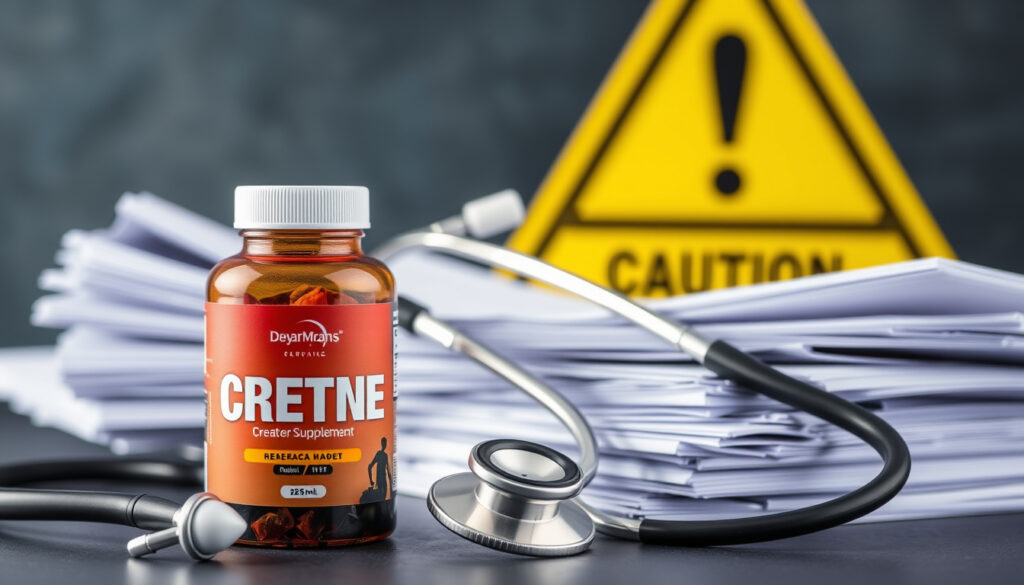
Creatine Side Effects: Risks, Safety, and What Research Says
Anyone who has ever tossed a scoop of creatine into a post-workout shake has probably heard a mix of warnings — about kidney damage, hair loss, or stomach cramps. The reality is more nuanced: most documented side effects are limited to gastrointestinal discomfort and a predictable weight gain from water retention, while far-fetched fears like kidney failure in healthy users simply don’t hold up under scrutiny.
Diarrhea incidence in athletes: 30% ·
Muscle cramps incidence: 25% ·
Dehydration incidence: 14% ·
Weight gain reported: Common ·
GI discomfort prevalence: Most common
Quick snapshot
- GI side effects (diarrhea, nausea) occur with high doses (AAOS OrthoInfo (orthopaedic medicine authority))
- Weight gain from water retention is consistent (Mayo Clinic (leading academic medical center))
- Muscle cramps and dehydration can occur (AAOS OrthoInfo)
- Whether creatine causes hair loss in susceptible individuals (Mayo Clinic)
- Long-term risk beyond 5 years in healthy adults (PMC / ISSN (sports nutrition research body))
- Side effect differences between creatine forms (Mayo Clinic)
- Side effects most common during loading phase (20 g/day for 5 days) (PMC review (recent meta-analysis))
- No established long-term side effect timeline (PMC review (recent meta-analysis))
- More research needed on female-specific side effects (PMC review (2021 safety review))
- Regulatory scrutiny of supplement quality expected (PMC review (2021 safety review))
Six key facts summarize what is known about creatine’s side effects and safety profile — one pattern: most concerns are manageable for healthy users.
| Fact | Details |
|---|---|
| What is creatine? | A naturally occurring amino acid derivative that helps produce energy in muscles. |
| Common side effects | GI discomfort, diarrhea, weight gain, muscle cramps. |
| Most feared but unproven | Kidney damage in healthy individuals; hair loss. |
| Safe daily dose | 3–5 g per day for healthy adults (Mayo Clinic). |
| Who should avoid? | People with kidney disease, those on nephrotoxic medications, or pregnant/nursing women (consult doctor). |
| Dehydration risk | Reported in 14% of athletes in one study (PMC review). |
| Long-term safety | Doses up to 30 g/day for 5 years considered safe in healthy individuals (PMC / ISSN Position Stand). |
What are the risks of creatine?
Common gastrointestinal side effects
- Diarrhea, nausea, and GI discomfort are the most frequently reported side effects. A 2025 analysis found that 30% of athletes experienced diarrhea during creatine loading (PMC review (2025 meta-analysis)).
- The American Academy of Orthopaedic Surgeons (AAOS) (orthopaedic medicine authority) lists nausea, vomiting, and diarrhea as recognized adverse effects.
- These effects are likely caused by unabsorbed creatine drawing water into the gut.
Weight gain and fluid retention
- Short-term loading of 20 g/day for 5 days can increase body weight by 1–3 kg, almost entirely from water retained inside muscle cells (PMC review).
- Mayo Clinic (leading academic medical center) confirms weight gain is a consistent side effect, not fat gain.
- GoodRx notes the weight is primarily water weight and reversible upon discontinuation (GoodRx (pharmacy pricing and health info platform)).
Risk of kidney damage in predisposed individuals
- For healthy adults, the Mayo Clinic states there is no evidence of kidney harm at recommended doses.
- However, a 2011 article in Clinical Kidney Journal (nephrology journal) reported that even recommended doses may cause kidney damage in people with pre-existing conditions.
- AAOS warns that creatine may be dangerous for those with kidney disease (AAOS OrthoInfo).
The pattern: The gastrointestinal side effects are dose-dependent and usually transient, while kidney risk is virtually nonexistent in people with normal kidney function. The weight gain is water, not fat — a cosmetic concern for some, but not a health risk.
Healthy users get performance and muscle gains with minimal downside. But for anyone with compromised kidney function, even the standard 3–5 g daily dose carries a real risk — and that caution is backed by multiple clinical sources.
Why do doctors say no to creatine?
Concerns about kidney and liver stress
- The American Medical Association (AMA) (physician-led medical association) notes that some doctors advise caution because long-term data in certain populations (e.g., adolescents, pregnant women) is limited.
- Ubie Health states creatine could place additional strain on kidneys in people who already have kidney problems (Ubie Health (symptom-checker platform)).
- Liver enzymes are rarely affected; no direct hepatotoxicity has been reported in clinical trials (PMC review (2021 safety analysis)).
Lack of regulation in the supplement industry
- Creatine is not FDA-approved as a drug, so quality varies between brands. The Cleveland Clinic (academic medical center) warns that contamination or incorrect dosing can occur.
- The International Society of Sports Nutrition (ISSN) (sports nutrition research body) emphasizes that pure creatine monohydrate produced by reputable manufacturers is safe — but not all products are equal.
Potential for misuse and overconsumption
- Taking more than the recommended 5 g/day increases side effect frequency without added benefit. Holland & Barrett (health retailer and supplement educator) warns that overdosing leads to more cramping and dehydration.
- The AMA reports that people often combine creatine with other stimulants, increasing cardiovascular stress.
What this means: Doctors’ skepticism stems from real uncertainties around manufacturing quality and vulnerable populations — not from proven danger in healthy adults. For a typical gym-goer, the medical consensus is that creatine is safe when used responsibly.
Is creatine safe for daily use?
Dosing guidelines for long-term use
- Daily doses up to 5 g for extended periods are considered safe for healthy individuals (Mayo Clinic).
- The ISSN position stand reports safety data for doses up to 30 g/day for 5 years in healthy individuals (PMC / ISSN).
- A 2021 review found creatine is relatively well tolerated at 3–5 g/day or 0.1 g/kg body weight (PMC review (2021)).
Safety in healthy adults vs. at-risk groups
- No evidence of adverse effects from long-term use in clinical trials up to 5 years (PMC / ISSN).
- People with kidney disease or those taking nephrotoxic medications should avoid or consult a doctor (Cleveland Clinic).
Common daily regimen and cycling
- Most users take 3–5 g daily without cycling. The Gatorade Sports Science Institute (GSSI) (sports performance research center) concludes that continuous daily use at recommended doses poses no threat to renal or hepatic systems.
The trade-off: Daily creatine is safe for the vast majority of healthy adults — the only real downside is the potential for mild GI discomfort, which can often be managed by splitting doses or taking with food.
The average lifter who takes creatine daily for years is not at risk. But people with undiagnosed kidney conditions — about 15% of U.S. adults — should screen first. That one kidney test could prevent an avoidable complication.
Which organ is affected by creatine?
Kidneys: theoretical risk and real-world incidence
- The kidneys are the main organ of concern because creatine is filtered and excreted by them. Mayo Clinic advises that research on creatine in people with kidney disease is limited.
- In healthy individuals, serum creatinine temporarily increases (a marker often mistaken for kidney damage), but actual renal function remains normal (GSSI).
Liver function and creatine
- Liver enzymes are rarely affected; no direct hepatotoxicity has been reported in peer-reviewed research (PMC review (2021)).
Muscle tissue as the primary target
- Creatine primarily acts on skeletal muscle, increasing water content and phosphocreatine stores. Cleveland Clinic notes this is the intended effect.
The implication: The kidneys are the only organ where a real risk exists — and only for those with pre-existing disease. For healthy users, creatine’s effect on muscle is a benefit, not a side effect.
Does creatine cause hair loss?
Mechanism: DHT production theory
- Some studies suggest creatine may increase dihydrotestosterone (DHT), a hormone linked to hair loss, but the evidence is weak and mixed (Holland & Barrett).
Clinical evidence from dermatologists
- A dermatologist review found no strong causal link between creatine and hair loss (Harvard Health (university health publication)).
Individual susceptibility and other factors
- Most major health sources — Mayo Clinic, Cleveland Clinic, AAOS — do not list hair loss as a confirmed side effect.
- The 2025 PMC review that reported 30% diarrhea incidence did not mention hair loss at all (PMC review (2025)).
The catch: The hair loss fear is largely anecdotal and not supported by robust data. If anything, the concern exceeds the evidence — a classic case of correlation mistaken for causation in the supplement world.
Can I take creatine if I don’t workout?
Effectiveness for non-exercisers
- Creatine can still increase muscle creatine stores even without exercise, but performance and muscle size benefits are less pronounced (1st Phorm (sports nutrition company)).
Possible side effects without training
- Side effect profile does not change; GI issues remain possible (AMA).
Cognitive and therapeutic benefits beyond exercise
- Some research suggests potential cognitive benefits for vegetarians or those with low baseline creatine. A PMC review (2021) found improvements in short-term memory and fatigue reduction in sleep-deprived individuals.
Why this matters: Taking creatine without working out is safe — you simply won’t see the muscle gains. For vegetarians or older adults, the cognitive and energy benefits may still make it worthwhile.
Upsides
- Well-studied safety record in healthy individuals — over 1,000 studies support it.
- Improves strength, power, and lean mass when combined with resistance training.
- Potential cognitive benefits for vegetarians and older adults.
- Inexpensive and widely available.
Downsides
- GI discomfort, diarrhea, and nausea during loading phases.
- Weight gain from water retention (cosmetic concern for some).
- Not recommended for people with kidney disease or those on nephrotoxic medications.
- Quality varies between brands due to lack of FDA regulation.
What’s confirmed and what’s unclear
Confirmed facts
- GI side effects (diarrhea, nausea) occur with high doses or loading phases (AAOS OrthoInfo).
- Weight gain from increased water retention is consistent (Mayo Clinic).
- Muscle cramps and dehydration can occur, especially with insufficient hydration (AAOS OrthoInfo).
- Short- and long-term supplementation (up to 5 years) is safe for healthy individuals (PMC / ISSN).
What’s unclear
- Whether creatine causes hair loss in susceptible individuals — evidence is weak and mixed.
- Whether long-term daily use beyond 5 years poses any risk in healthy adults — no long-term data beyond that horizon.
- The effect of different creatine forms on side effect profiles — monohydrate is the most studied.
Expert perspectives: what the research says
“The most common side effects are nausea and GI discomfort.”
— AMA expert (Dr. Johnathan), American Medical Association (physician-led medical association)
“Negative effects include dizziness, nausea, vomiting, diarrhea, excessive sweating.”
— Cleveland Clinic (academic medical center)
“30% of athletes reported diarrhea, 25% muscle cramps, 14% dehydration.”
— Longobardi et al., 2025, PMC review (2025 meta-analysis)
“Available data indicate creatine monohydrate used properly poses no threat to the renal system.”
— Gatorade Sports Science Institute (sports performance research center)
For the average healthy adult, the side effects of creatine are manageable and temporary — and the more dramatic fears (kidney failure, permanent hair loss) are not backed by the weight of evidence. However, for those with kidney disease, undiagnosed conditions, or concerns about supplement quality, the cautious approach is warranted. The choice is clear: check your kidney function, stick to reputable brands, and keep your daily dose at 3–5 grams. Your muscles will thank you, and your kidneys probably won’t notice.
Related reading: **Best Fish Oil Supplement: How to Choose & What to Look For** · **High Calcium in Blood: Causes, Symptoms, and Treatment**
Frequently asked questions
Can creatine cause bloating?
Yes, some users experience bloating during the loading phase due to water retention in muscle cells. Splitting doses and staying hydrated can reduce this effect.
Does creatine interact with medications?
Creatine may interact with nephrotoxic drugs (e.g., NSAIDs, certain antibiotics). Always consult a doctor if you take medication regularly (Mayo Clinic).
Is creatine safe for teenagers?
Research is limited. The AMA advises caution and recommends consulting a pediatrician before use.
What form of creatine has the fewest side effects?
Creatine monohydrate is the most studied and generally the best tolerated. Other forms (ethyl ester, buffered) claim fewer GI issues but lack strong evidence (PMC review).
How can I reduce creatine side effects?
Take creatine with food, split doses (e.g., 2 g twice daily), avoid loading phases, and drink plenty of water. These steps significantly lower GI discomfort (AAOS OrthoInfo).
Does creatine cause stomach pain?
Stomach pain is a recognized side effect, especially during loading. The Cleveland Clinic lists it among common GI complaints.
Can creatine be taken on an empty stomach?
It can, but it may increase the risk of stomach upset. Taking it with a meal reduces GI irritation (Holland & Barrett).
Is it safe to take creatine with caffeine?
Moderate caffeine intake (≤200 mg) does not appear to affect creatine absorption or safety. Higher doses combined with creatine may increase dehydration risk (PMC review).
More related posts
 Red Dots on Skin: Causes, Types, When to Worry
 Ole Miss vs Miami: 31-27 Final, Fiesta Bowl Recap & Highlights
 A hton Jeanty NFL Draft: Pick, Team, Combine & Contract
 How to Clean iPhone Charging Port: Safe DIY Steps
 Lassen Volcanic National Park: Yellowstone Without Crowds
 Is Flamin’ Hot Mountain Dew Discontinued? Facts
 AT&T Data Breach Settlement: Payouts, Eligibility & How to Claim
 What is Section 8? US Housing, UK Law & Slang Explained