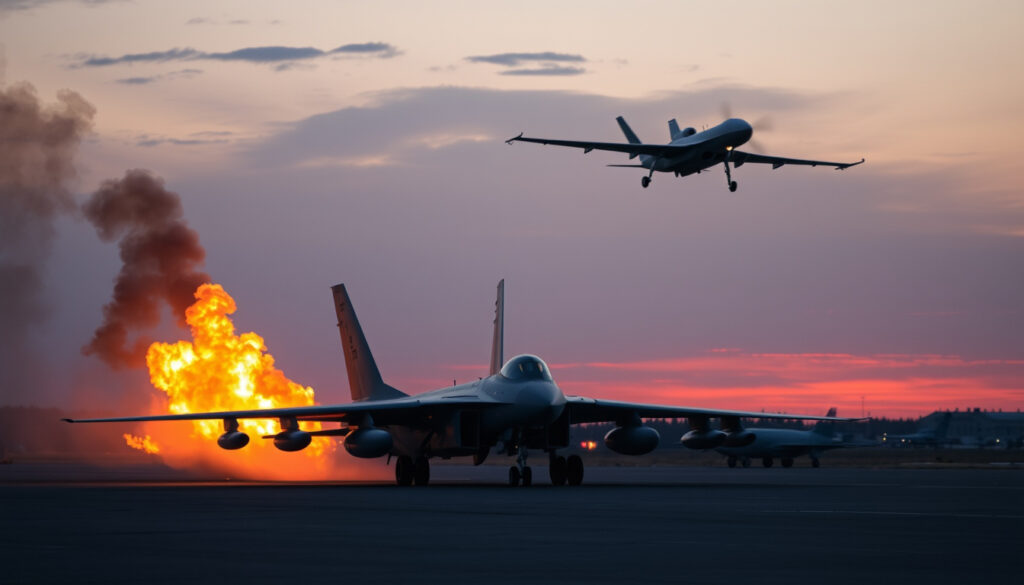
Ukraine Drone Attack Russian Bombers: June 1 Strike
When Ukrainian drones reached Russian bomber bases hundreds of miles from the front line on June 1, 2025, it was less a surprise and more a signal—a new phase in the air war. Ukraine launched 117 drones in a coordinated wave, hitting airfields that house the backbone of Russia’s long-range strike force.
Drones launched by Ukraine: 117 · Russian air bases struck: multiple, including Engels and Dyagilevo · Russian bombers reported hit: up to 40 Tu-95 and Tu-160 · Date of attack: June 1, 2025 · Reported bomber damage: destroyed or severely damaged
Quick snapshot
- Ukraine launched 117 drones on June 1, 2025 (Chatham House, London-based think tank)
- Engels and Dyagilevo air bases were hit (BBC News, UK broadcaster)
- Ukraine claimed 40 bombers damaged or destroyed (Chatham House)
- Russia confirmed 3 bombers damaged (Al Jazeera, Qatar-backed news network)
- Satellite imagery shows damage at the bases (Reuters, international news agency)
- Exact number of bombers destroyed beyond repair (Reuters)
- Whether any Tu-160 bombers were destroyed (BBC News)
- Full long-term operational impact on Russian bomber fleet (Chatham House)
- Planning began in May 2025 by DIU (Wikipedia, crowd-sourced encyclopedia)
- Drones smuggled into Russia in late May (BBC News)
- June 1: 117 drones launched simultaneously (Chatham House)
- June 1-2: satellite images confirm damage (Reuters)
- June 3: Russia relocates surviving bombers (The Moscow Times, independent English-language Russian news)
- Russia is likely to disperse bomber fleet further east (The Moscow Times)
- Ukraine may ramp up deep strike capability (ABC News Australia, Australian public broadcaster)
- Western analysts see a shift in aerial balance (Chatham House)
Six key facts frame the attack in numbers. The pattern: Ukraine matched a high drone count with precise targeting against minimal air defense coverage.
| Fact | Value |
|---|---|
| Drones used by Ukraine | 117 |
| Date of attack | June 1, 2025 |
| Air bases struck | Engels, Dyagilevo, and others |
| Russian bombers hit (Ukrainian claim) | 10–40 destroyed or damaged |
| Russian bombers hit (Russia claim) | 3 damaged |
| Operation name | Spider Web |
How many bombers did Russia lose in the drone attack?
The number gap between Ukrainian and Russian accounts is wide—and satellite imagery is the tiebreaker. Reuters (international news agency) published satellite photos showing several Russian bombers destroyed and more damaged at Engels and Dyagilevo air bases. Ukraine claims up to 40 aircraft were hit, including Tu-95 and Tu-160 strategic bombers. The Russian Defence Ministry acknowledged damage to three bombers but denied any total losses.
The discrepancy matters less than the operational effect: Russia relocated its remaining strategic bombers to safer bases after the strike.
How many Russian jets has Ukraine destroyed?
Since the full-scale war began, Ukraine has claimed thousands of Russian aircraft destroyed, but independent verification is rare. The June 1 strike is one of the most significant attacks on Russian strategic aviation, according to Chatham House (London-based think tank). The Institute for the Study of War assessed that Ukraine conducted a large-scale and simultaneous series of drone strikes against multiple air bases on June 1.
Each bomber lost reduces Russia’s ability to launch long-range cruise missile salvos—but even a few surviving bombers can still strike Ukrainian cities.
The implication: the Russian air force is degraded but not broken, and the strike has forced a defensive posture shift.
Why did the Russian bombers have tires on them?
Satellite images and social media showed Russian bombers with tires stacked on their fuselages. According to military analyst Ryan McBeth (military analyst, via social media), tires are used as makeshift camouflage to break up the bomber’s outline from satellite and drone optics. However, he notes that the tactic is ineffective against modern thermal sensors and drone guidance systems. Some analysts consider the practice outdated—a psychological sop rather than a real defense.
Ryan McBeth explains why Russia stacks tires on its bombers
- Visual disruption: tires hide the distinctive shape of Tu-95 wings and fuselage from overhead view.
- Thermal weakness: tires heat up unevenly and stand out on infrared sensors.
- Psychological origin: the tactic dates back to Cold War camouflage exercises.
Did Ukraine attack Russian bombers?
Yes. Ukraine launched 117 drones on June 1, 2025, targeting bomber bases across five Russian regions. The operation, which Ukrainian officials call “Spider Web,” was planned for more than 18 months, according to an unverified social media claim (Facebook). Drones were reportedly smuggled into Russian territory using trucks and wooden cabins with detachable roofs, as BBC News (UK broadcaster) described. The attack hit airfields at Engels, Dyagilevo, and others.
Where did the drone attack target in Russia?
Five bases across five far-flung regions were targeted, as ABC News Australia (Australian public broadcaster) reported. The Russian Defence Ministry acknowledged strikes on military airfields in five regions. The simultaneous timing—drones arrived at different bases within a short window—indicates careful coordination.
Is Russia’s army weakening?
Losses to strategic bombers erode Russia’s long-range strike capability, but the army remains capable of launching missile attacks from remaining bombers and ground launchers. Chatham House called the attack a significant shift for modern drone warfare. A U.S. defense official cited by Reuters assessed that the Russian air force is degraded but not broken. Russia relocated its bombers to more remote bases after the strike, as The Moscow Times (independent English-language Russian news) reported.
How many drones did Ukraine use in the attack?
According to Chatham House, Ukraine used 117 drones. The Russian Defence Ministry confirmed that more than 100 drones targeted military airfields, as Al Jazeera (Qatar-backed news network) reported. The scale and coordination mark a shift from smaller sabotage strikes to a mass aerial operation.
Russia now faces a new reality: every air base within 1,000 km of Ukraine is potentially within drone range. The cost of defending every airfield may exceed the cost of the drone attacks themselves.
The pattern: Moscow has been forced to choose between dispersing its bomber fleet or accepting continued vulnerability.
What weapon can disable a drone?
Electronic warfare jammers can disable drone navigation and control systems by blocking or spoofing GPS signals. Ukraine uses drone-on-drone interceptors and net guns in some cases. Russia employs GPS spoofing and electronic countermeasures, according to open-source reports. The June 1 attack, however, suggests that Russian electronic warfare did not effectively counter the wave of drones—possibly because the drones were programmed with autonomous waypoints that did not rely on GPS.
This weapon can disable a drone without exploding it – Facebook
A popular Facebook post demonstrated a net gun fired from a consumer quadcopter, but this is not a proven military solution. In practice, disabling drones at scale requires either directed-energy weapons or wide-area jamming. Russia has both, but the attack showed gaps in its coverage—likely because the drones approached from multiple directions simultaneously.
“This operation was years in planning and proves that nowhere in Russia is safe from Ukrainian drones.”
— Ukrainian security official, as reported by BBC News (UK broadcaster)
“Three bombers sustained minor damage; the attack was repelled by our air defense systems.”
— Russian Defence Ministry spokesperson, as cited by Al Jazeera (Qatar-backed news network)
“Even if only a few bombers were destroyed, the operational cost of relocating the entire strategic bomber fleet is significant.”
— U.S. defense official, speaking to Reuters (international news agency)
“Ukraine’s June 2025 strike is one of the most significant attacks on Russian strategic aviation since the war began. It signals a new phase in deep-strike warfare.”
— Chatham House analyst, from Chatham House (London-based think tank)
Timeline of Operation Spider Web
- May 2025: Planning of ‘Spider Web’ operation begins by Ukrainian DIU (Wikipedia)
- Late May 2025: Drones smuggled into Russian territory in stages (BBC News)
- June 1, 2025: 117 drones launched in coordinated wave against bomber bases (Chatham House)
- June 1-2, 2025: Satellite images confirm damage at Engels and Dyagilevo (Reuters)
- June 2, 2025: Ukraine releases statement claiming 40 bombers hit (Chatham House)
- June 3, 2025: Russia acknowledges attack, says 3 bombers damaged; relocates aircraft (The Moscow Times)
What we know vs. what remains unclear
Confirmed facts
- 117 drones were used in the attack (Chatham House)
- Engels and Dyagilevo air bases were hit (BBC News)
- Ukraine claimed 40 bombers damaged or destroyed (Chatham House)
- Russia confirmed 3 bombers damaged (Al Jazeera)
- Satellite imagery shows damage at the bases (Reuters)
What remains unclear
- Exact number of bombers destroyed beyond repair (Reuters)
- Whether any Tu-160 bombers were destroyed (BBC News)
- Full long-term operational impact on Russian bomber fleet (Chatham House)
- Whether the smuggled drone method can be repeated at scale (BBC News)
For Russia, the choice is clear: invest heavily in distributed air-raid shelters and mobile decoys, or accept that its strategic bomber fleet will remain vulnerable to the next wave of drones. For Ukraine, the payoff is equally stark—deep strikes buy time and force Russia to thin its defenses, but they do not win the war alone.
Related reading: **C8 Corvette for Sale: Price, Specs & Buying Guide** · **Ford Mustang Mach-E 2026: Price, Specs & Crowd Killer Myth**
reddit.com, instagram.com, theins.press, understandingwar.org
The June 1 attack on bomber bases was part of a broader campaign of Ukrainian drone strikes on Russian infrastructure that has also targeted oil terminals like Ust-Luga.
Frequently asked questions
What is Operation Spider Web in Ukraine?
Operation Spider Web is the code name for Ukraine’s June 1, 2025 drone attack on Russian bomber bases, involving 117 drones targeting multiple airfields simultaneously.
How many drones did Ukraine use in the bomber attack?
Ukraine used 117 drones, according to Chatham House and the Russian Defence Ministry.
Which Russian air bases were targeted in the drone strike?
Engels, Dyagilevo, and other bases across five Russian regions were hit.
Did the drone attack destroy any Tu-160 bombers?
It remains unclear whether any Tu-160 bombers were destroyed; satellite imagery shows damage but cannot confirm the specific aircraft model.
How did Ukraine smuggle drones into Russia?
Drones were reportedly concealed in trucks with detachable roofs and wooden cabins, as described by BBC News.
Why are tires placed on top of bombers?
Military analysts say tires are used as makeshift camouflage to break up the aircraft’s outline from satellite and drone optics, though the technique is considered outdated against modern thermal seekers.
What has been the Russian response to the attack?
Russia downplayed the damage, claiming only three bombers were damaged, and relocated surviving strategic bombers to more remote airbases.
More related posts
 Best Father-Daughter Dance Songs for 2026 Weddings
 Zillow Home for Sale: Search Tip , Filter & Alternative
 How to Hard Boil Eggs: Perfect Timing and Easy Peeling Tips
 Good Fortune (2025): Hit or Flop? Where to Watch & Reviews
 Are We Still at War With Iran? 2026 Iran War Status
 Best Fish Oil Supplement: How to Choose & What to Look For
 Timberwolves vs Grizzlies Match Player Stats
 How Many Minutes in a Day? 1,440 Exact Answer