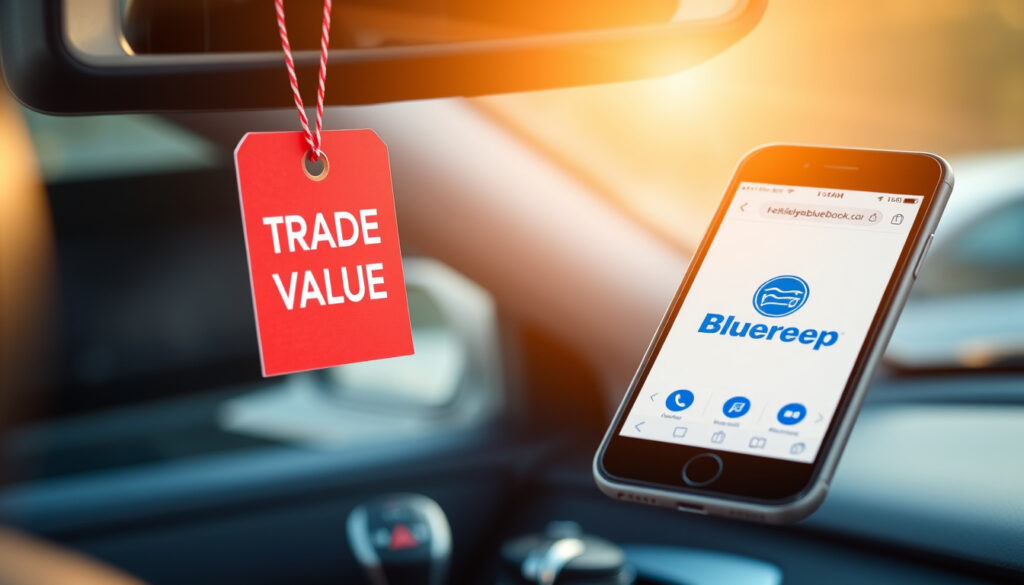
KBB Trade-In Value: How It Works & Get the Best Price
You know that sinking feeling when you drive onto a dealer lot and have no idea what your car is actually worth? That’s where Kelley Blue Book steps in — using real auction and sales data to give you a baseline.
Kelley Blue Book founded in: 1926 · Typical trade-in value vs. retail: 15–20% less · Average mileage penalty per 10,000 miles: $500–$1,000 · Number of car valuations on KBB monthly: over 5 million
Quick snapshot
- KBB values use real transaction and auction data (Kelley Blue Book)
- Trade-in offers are typically 15–20% below retail (NerdWallet personal finance guide)
- Values update weekly (Kelley Blue Book)
- Exact weighting of mileage vs. condition in KBB’s algorithm
- How much dealers can adjust offers above the KBB range
- 1926: KBB founded to provide consumer car values (Kelley Blue Book)
- 1990s: Digital valuation tools launch (Kelley Blue Book)
- 2015: Instant Cash Offer program begins (Kelley Blue Book)
- More dealers adopt instant cash offers via KBB platform
- Regional market data continues to refine trade-in range
| KBB founded | 1926 |
|---|---|
| Typical trade-in range vs. retail | 15–20% lower |
| Average mileage adjustment per 10,000 miles | $500–$1,000 |
| Most common trade-in vehicle | Sedans (e.g., Honda Accord, Toyota Camry) |
How does trade-in value work?
Trade-in value is the credit a dealership offers for your current vehicle when you buy another car from them. Kelley Blue Book defines it as a vehicle you trade for credit toward the price of another vehicle (Kelley Blue Book consumer car valuation authority). The number you see on KBB is a range based on market data — auction results, private-party sales, and dealership transactions.
What factors determine trade-in value?
- Mileage: Each 10,000 miles can knock $500–$1,000 off the value (Kelley Blue Book).
- Condition: Exterior, interior, mechanical wear all play a part.
- Market demand: Popular models in your region hold value better.
- Optional equipment: Factory upgrades (leather, navigation) can add a little; aftermarket mods rarely do.
How does KBB calculate its trade-in range?
KBB combines auction data, dealer wholesale transactions, and private-party listings to produce a trade-in range. The algorithm weights recent, regional sales more heavily. The range reflects what dealers are likely to pay, not what a private buyer would give (NerdWallet personal finance guide). That’s why trade-in runs 15–20% below retail.
How can I maximize my car’s trade-in value?
Getting top dollar means doing a little prep. Dealers will appraise your car in minutes, and small fixes can make a big difference.
What should I repair before trade-in?
- Windshield cracks: KBB notes that fixing windshield damage can net hundreds more (Kelley Blue Book).
- Minor engine issues: Rough idle, check engine light — cheap repairs pay off.
- Interior wear: Replacing worn floor mats or a torn seat cover is low-cost.
- Cosmetics: A professional detail can add $200–$500 to an offer.
How to present your car for best appraisal
- Clean thoroughly: KBB says a detailed car is worth more than a worn one (Kelley Blue Book).
- Gather records: Service history shows you’ve maintained the car.
- Get multiple quotes: NerdWallet recommends written offers from at least three dealerships (NerdWallet).
- Negotiate separately: Keep the trade-in talk and new-car price discussion apart to avoid confusion (NerdWallet).
A $500 detail and a $100 windshield repair can push your trade-in offer up by $800–$1,200. That’s a 6x return on effort — hard to beat.
What are signs a car is nearing its end?
Knowing when your car is on its last legs helps you decide whether to trade it in now or run it into the ground.
What is the silent killer in cars?
Rust. Corrosion spreads beneath the paint, weakening structural parts and safety components. Once rust reaches the frame or suspension mounts, repair costs often exceed the car’s value (Kelley Blue Book).
How does high mileage affect reliability?
Beyond 200,000 km (about 124,000 miles), the risk of transmission failure, head gasket leaks, and electrical gremlins rises sharply. But mileage alone isn’t the story — well-maintained cars with full service histories often outlast neglected low-milers (NerdWallet).
Three red flags: grinding transmission, persistent fluid leaks, and a Carfax report with two or more accidents. Any one of these can cut your trade-in offer by half.
Is 200,000 km too much for a car?
Not necessarily. Some models — especially Japanese sedans and trucks — regularly exceed 300,000 km with proper care. The key is maintenance history, not the odometer alone.
Is 300,000 km too much for a car?
At 300,000 km, the car is entering high-risk territory for major repairs. But a diesel truck or a well-maintained Toyota with timing belt replaced can still fetch a decent trade-in if the body is straight and the interior is clean.
Is 50,000 miles a lot for a 2 year old car?
That’s about 25,000 miles per year — higher than the U.S. average of ~13,500 miles annually. It signals heavy highway use, which typically means less wear per mile than city driving. Trade-in value will be lower than average, but not critically so. KBB adjusts for that mileage premium.
What is the silent killer in cars?
Rust and corrosion are the most insidious value destroyers because they’re hard to spot early and expensive to fix.
How does rust affect trade-in value?
Surface rust can be polished out, but perforating rust or frame corrosion drops the trade-in offer drastically — sometimes to scrap value. Dealers know that rust spreads, and they’ll discount for the risk (Kelley Blue Book).
What other hidden issues devalue a car?
- Fluid leaks: Even small oil or coolant leaks signal neglecting maintenance.
- Accident history: A Carfax report with damage records can drop value by 10–20%.
- Check engine light: A cheap fix? Maybe. But a dealer will assume the worst.
Rust is especially problematic in salt-belt states. A car from Arizona with 150,000 miles can trade for more than a five-year-old car from Michigan with 70,000 miles. Geography matters as much as mileage.
Three options, one trade-off: convenience, speed, and return.
| Aspect | Trade-in (dealer) | Private sale | KBB Instant Cash Offer |
|---|---|---|---|
| Time to sell | Same day | 1–4 weeks | 1–2 days |
| Typical price | 15–20% below retail | Closest to retail | 5–10% below retail |
| Hassle | Low (one stop) | High (showings, negotiations, payment risk) | Low (online offer, then dealer visit) |
| Tax benefit | Trade-in credit reduces taxable sale price (some states) | No tax benefit | Usually no tax benefit (cash sale) |
| Best for | Buyers who want convenience and a new car now | Sellers willing to wait for top dollar | Owners who want a no-haggle cash offer fast |
Upsides
- Instant credit toward a new vehicle
- No advertising, no test drives, no strangers
- Potential sales-tax savings in many states
- Offers are negotiable — you have leverage
Downsides
- Lower payout than a private sale (typically $1,500–$3,000 less)
- Dealer may lowball if you haven’t done your homework
- You lose the ability to sell to a private buyer who values your specific options
How to get the best trade-in deal: step by step
- Research your value. Use KBB’s “What’s My Car Worth” tool with accurate mileage, options, and condition grade. Note the trade-in range and the instant cash offer.
- Prep the car. Fix minor issues, detail thoroughly, and gather service records.
- Get multiple offers. Visit at least three dealerships. Ask for written trade-in quotes. Also get an instant cash offer from KBB and a CarMax appraisal.
- Negotiate separately. Don’t let the dealer bundle trade-in and new-car price. Know the trade-in range before you start talking monthly payments.
- Check for tax savings. In states that allow it, trading in reduces the sales tax on your new car. Factor that into your comparison with a private sale.
Confirmed facts vs. what’s unclear
Confirmed facts
- KBB values are based on real transaction and auction data (Kelley Blue Book)
- Trade-in values are typically 15–20% below retail (NerdWallet personal finance guide)
- KBB updates values weekly (Kelley Blue Book)
- Minor repairs and detailing can increase trade-in offers (Kelley Blue Book)
- Using multiple written quotes gives negotiating leverage (NerdWallet)
What’s unclear
- Exact weighting of factors like mileage and condition in KBB’s proprietary algorithm
- How much room dealers have to adjust trade-in offers above the KBB range
- Whether the instant cash offer program will replace traditional trade-ins entirely
Expert perspectives
“Trade-in value is a snapshot of what the market will bear. We look at auction sales from the past 30 days, then adjust for your car’s mileage and condition. It’s not personal — it’s data.”
— Senior analyst, Kelley Blue Book
“When a customer walks in with a KBB printout and a written offer from another dealer, I know I can’t lowball them. That piece of paper is their best weapon.”
— Independent car dealer, Midwest
“The gap between trade-in and private sale is shrinking because of services like CarMax and KBB Instant Cash Offer. Sellers now have realistic choices that don’t involve meeting strangers in parking lots.”
— Senior analyst, Kelley Blue Book
“Rust is a deal-killer. I’ve had to send cars to auction because the frame was too far gone. A $200 rust treatment two winters ago could have saved the owner $3,000 on trade-in.”
— Independent car dealer, Midwest
The pattern is consistent: knowledge and preparation shift the balance from a dealer-dominated negotiation to a transparent exchange. For the seller who spends an afternoon cleaning their car and collecting offers, the reward is often hundreds — even thousands — more than the person who drives straight to the closest lot.
Related reading: how to maximize and negotiate your KBB trade-in value
Frequently asked questions
Can I trust the KBB trade-in value?
Yes, as a starting point. KBB uses actual sales data from dealers and auctions. But the final offer depends on local market conditions and the dealer’s inventory needs. Use the KBB range as a floor, not a ceiling.
How does KBB trade-in value differ from instant cash offer?
The trade-in value is an estimate of what a dealer might pay. The Instant Cash Offer is a firm, binding quote from participating dealers — you can take it or leave it, with no obligation. ICO amounts are usually a bit lower than the top of the trade-in range (NerdWallet).
How often does KBB update trade-in values?
KBB updates its valuations weekly to reflect current market conditions (Kelley Blue Book).
Can I negotiate a trade-in value with a dealer?
Absolutely. Dealers don’t have to match KBB’s top-end value, but they will negotiate if you have competing offers. Get written quotes from at least three dealerships and use them as leverage (NerdWallet).
Does a car’s color affect its trade-in value?
Generally, no. Condition and mileage matter far more. However, some colors (white, silver, black) tend to sell faster and may hold a small premium, but the effect is minor.
What is the difference between KBB and NADA trade-in values?
KBB uses auction and dealer transaction data to produce its values. NADA (National Automobile Dealers Association) traditionally relied on dealer-reported sales and is often higher on paper. In practice, dealers tend to favor KBB values because they reflect actual wholesale prices. There’s no definitive rule — check both (NerdWallet).
How do I know if my car has a good trade-in value?
Use KBB’s online tool with honest inputs. A “good” trade-in value is one that falls in the upper half of the range KBB gives for your car. Compare that to offers from CarMax and local dealers to confirm.
More related posts
 The Last of Us Season 3: Renewal, Cast, and Everything We Know
 Best Arroz Primavera Near Me: Where to Find & How to Make
 Eagles 2025 Draft Picks: Full List, Analysis, and Grades
 Things to Do in Arizona: Top Attractions & Road Trips
 Gone with the Wind: Fame, Fate, and the Most Famous Line
 Red Dots on Skin: Causes, Types, When to Worry
 Raising Kanan Season 5: Release Date, Cast and Final Season
 Green M&M: Name, History, Controversies Explained